
 The setting for our screenplay is a big Louisiana mansion… isolated, creepy. You know the type. Initially I wanted to have the house be in a swampy area near New Orleans, but historically speaking, it just wouldn’t work for the dual time periods our story takes place in. So, after a week of working on arbitration stuff, I did a little southern plantation location scout.
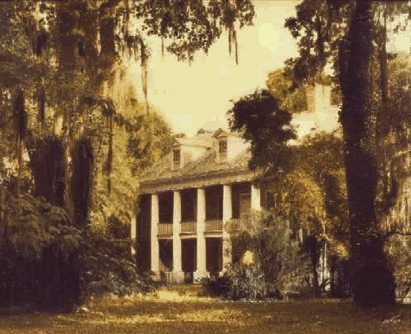
 First I drove west, through swamps and sugar cane fields, to New Iberia, Louisiana, which I think sounds kind of cool. Kind of a rural southern cool. The first plantation I went to was called The Shadows. Perfect creepy name. It’s called The Shadows because it sits in the shadows of big oaks around it.
The house now:

The house at the turn of the century (the first time period of our story):
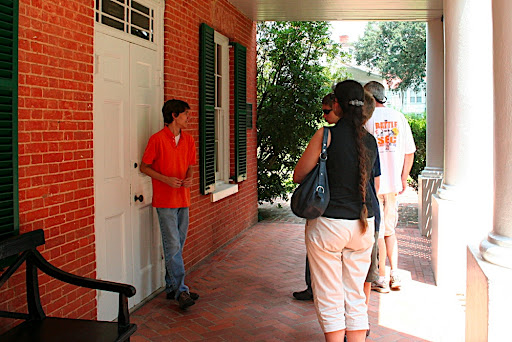
The tour guide was 19, had this classic Louisiana accent, and knew all about the house. He was adorable, I wanted to put him in my pocket.
A little backyard cemetery at the Shadows. I'm sure you have one just like it:

I toured another house in New Iberia, called Joe Jefferson after the actor who built it in 1870. I got there about 4:05, five minutes after the last tour began, and the woman was totally not going to let me join.
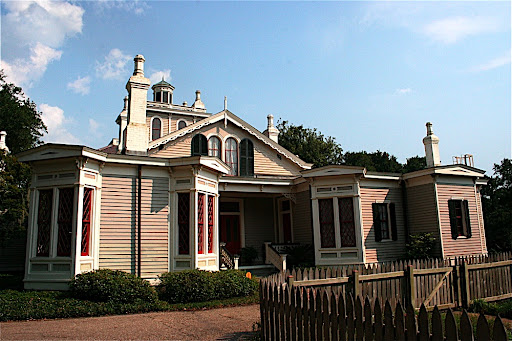 Finally after some pleading, she was like, well, I don’t know, I guess we can see how much you’ll disrupt the group. So I caught up with the tour… which had two people in it. After the tour, I watched a video on the house, and it was basically a “get married here” ad. I so wish I could show you the video, because it most dramatic wedding ad I have ever seen. The music was, like, from a war movie or something. There were these brides wandering around the gardens in soft focus, and I kept expecting a scary clown to jump out, or there to be a subtitle that said, “Kimberly’s body was discovered the next morning, but they never found her head.”
 I drove home through a pretty sunset. Ah, clouds, how I miss you. Brie and I got pizza at Mona Lisa, I think, and fortified ourselves with Hand Grenades from Tropical Isle (which we didn’t even finish, we just wanted to get drinks “to go” at some point…
  New Orleans has really mastered the drinks that taste like kool-aid) so that we could stand to watch Skeleton Key. Not the greatest movie ever, but scary enough that we decided Brie should sleep in the bedroom with me that night. I had trouble sleeping because there was this intermittent scratching, tapping noise coming from somewhere in the room. I thought it was Brie messing with her phone. Until she said, “What’s that noise?” And I, in classic Scooby Doo fashion, answered, “I thought it was you.”
And then a scary clown jumped out. We never found Brie’s head.
Actually, we never figured out what the noise was. I like to think it was an army of giant roach ghosts. I especially liked hearing it after Brie left and I was in the apartment by myself.
 The next day Paul and Brie went with me to tour plantations on the River Road. We took a tour at Laura Plantation, a Creole sugar plantation. The word Creole, I found, refers to several different people groups in Louisiana, but the oldest, most traditional definition, and the one that’s intended here, is a person descended from the French who settled in Louisiana before the Louisiana Purchase.
  There were a lot of interesting details on the tour because it’s based on the memoirs of Laura Locoul, whose family built the plantation, and who got annoyed when Gone With The Wind was published and wrote a book to show her family what plantation life in the 1800’s was really like.
 Near Laura Plantation was the B&C Seafood Market and Cajun Restaurant, where we stopped to get lunch. Paul insisted that we get a Cajun sampler platter, which included many, many fried things. Including fried alligator, which we all tried. You could also get an alligator po’ boy, but none of us were up for that.
 We drove further up the River Road and saw a few more plantations, but didn’t take any more tours.
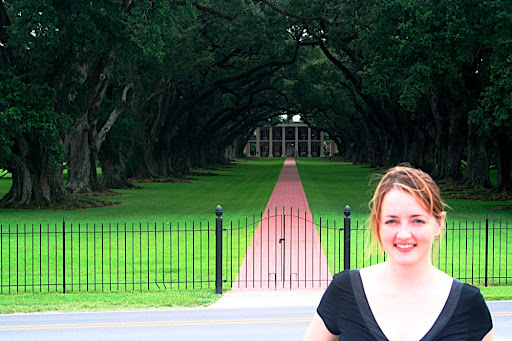
Me in front of Oak Alley, which I plan to buy and use as a getaway from the harsh Los Angeles winters:
 We also did some sleuth work and found Felicity Plantation, which was where Skeleton Key was shot. We were perhaps not technically allowed on the property, but I really wanted to see how it looked. It was actually a sugar cane plantation and is surrounded by fields, so they created swamps with a hose and some CG.
 It’s a cool location, I can see why they picked it. It would be so fun to direct a movie in a great authentic building like that. Someday.
Through the pouring rain, Paul showed us an old house he broke into once with friends. It’s not inhabited, I think they were just being hoodlums. It actually wouldn’t be too bad for a movie, either.

After this house, Paul said we could take the bridge over the Mississippi and head back to New Orleans. But we kept driving… and driving… and no bridge. At some point it became clear that we just needed to turn around and go back the way we came, but it was one of those things
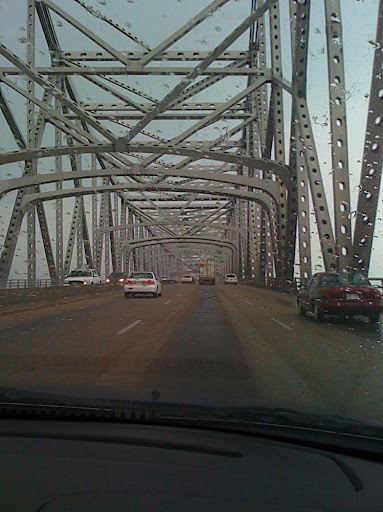 where you would rather drive literally two hours out of your way rather than just admit you missed something and should just turn around already. And by you, I mean Paul. Personally, I was not voting for continuing to drive and drive and drive and drive until we hit Baton Rouge, but that’s what we did. We finally crossed the river at Baton Rouge and headed home on the interstate instead of taking the River Road on that side.
That night Brie and I walked down to Preservation Hall to hear jazz. We got there during the
 second set, and had to sit in the hall, where we could hear but not see. During the break, some people cleared out, and we were able to move into the main room and snag a bench. It isn’t air conditioned and it was kind of ridiculously hot, but so fun. I didn’t think I liked jazz. It always seems kind of rambly and pointless. But I loved the jazz we heard.
  Maybe it was Jazz for Dummies. Requests cost two bucks, five for standards, ten for “The Saints,” which they ended up getting two twenties for. Two I can remember were “Do You Know What It Means” and “St. James Infirmary.”
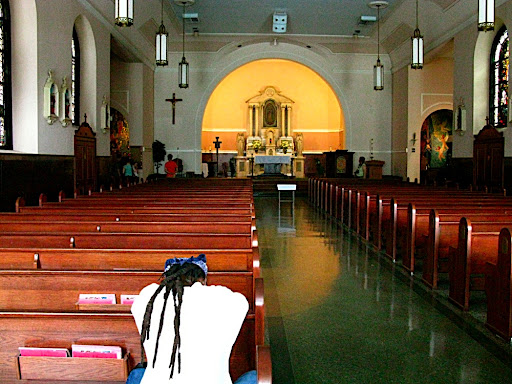
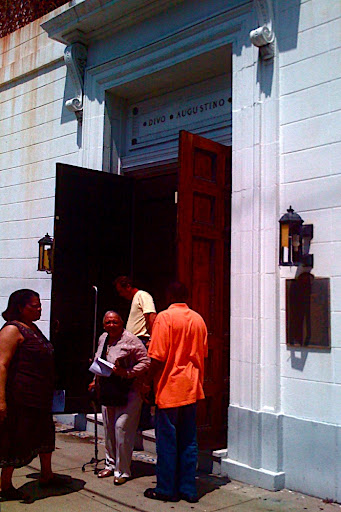
Paul had mentioned a plantation called The Myrtles that is creepy and supposedly haunted, so the next day, after eating praline bacon (pork candy) at Elizabeth’s in the Bywater and attending mass at St. Augustine’s, Brie and I decided to drive up to St. Francisville to see it.
 Here’s the story told at the plantation:
The house was built in 1794 by General David Bradford, whose daughter, Sarah Matilda, married a judge named Clark Woodruff. Over the years, Woodruff began having an affair with one of the slaves, named Chloe, who he brought into the house to watch the children.
 But Chloe had a habit of eavesdropping on her lover and his wife, so, as a punishment, he cut off her ear and sent her back to the fields. She wore a green turban to cover her missing ear and began scheming to get back into the house.
She decided to poison the children by putting oleander in the birthday cake they were served. She just wanted them to get sick enough that she would be called back in from the fields
 to care for them, and when she was able to make them better, she would be back in the good graces of the family. So she carried out her plan, but ended up killing both children and Sarah Matilda. The other slaves, afraid of being blamed for the deaths, killed Chloe and threw her body in the river. Ever since, the house has been haunted by an apparition wearing a green turban. And this apparition likes to pose for photos:
 Apparently, says the guide, this photo was taken when the house was completely empty, and a super special “shadow density” filter was put on the photograph, which then showed the outlines of two children playing on the roof. Ghost children like to play on the roof, you see, because it doesn’t matter if they fall.
 It was a custom, the guide told us in a serious voice, for mirrors to be covered after a death, because it was believed that if they were not, the soul could escape the body and be pulled into the mirror, where it would remain trapped. Forever! And on the death day of Sarah Matilda, the two children, and Chloe, the house must have been in too much of an uproar to cover all the mirrors, and so their souls were pulled into this mirror. You can see their ghostly handprints, where they tried to get out!
It’s a good story. Too bad Sarah Mathilde and the children all died of yellow fever. The one murder that did actually occur at the house - William Winter was killed on the porch in a horseride-by shooting in 1874 - was not even mentioned on the tour. I think they were saving it for the Friday Night Mystery Ghost Tour.

The grounds were really nice. There was a little swamp island that I could barely tear Brie away from, and a lamppost in the lawn.
Brie, as Gene Kelly:
 Brie, as Tumnus:
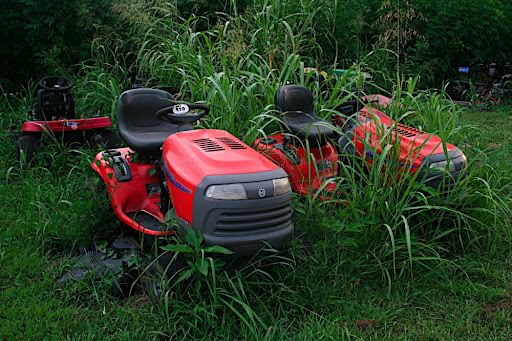
 On the way back I had a huge craving for a snoball, so we drove around Baton Rouge until we found a stand. While waiting for my delicious watermelon-strawberry snoball to be prepared, I took some pictures of the little crop of tractors growing behind the stand:
 And the sign for the restaurant next door, Fricken Chicken: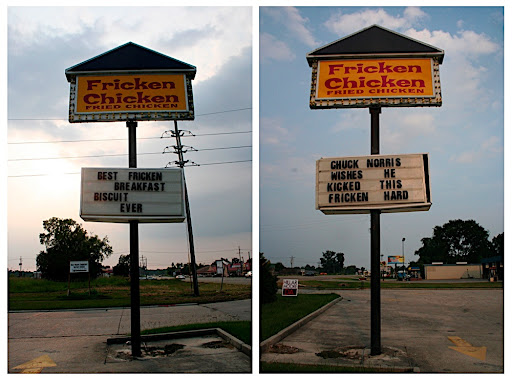
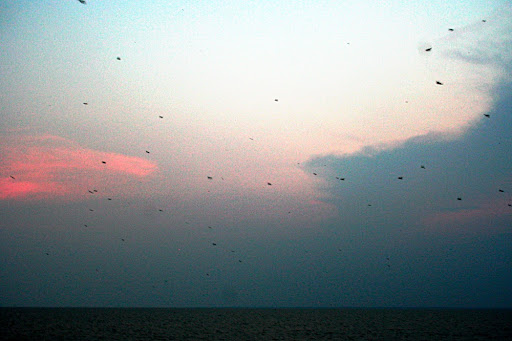 We drove the long way home from Baton Rouge so that we could take the Lake Pontchartrain Causeway, which at 24 miles is the longest bridge in the world. We drove across at sunset, and the sky was filled with Mexican freetail bats! My little buddies from Carlsbad! I thought it was pretty great. So great that I nearly drove into the side of the bridge.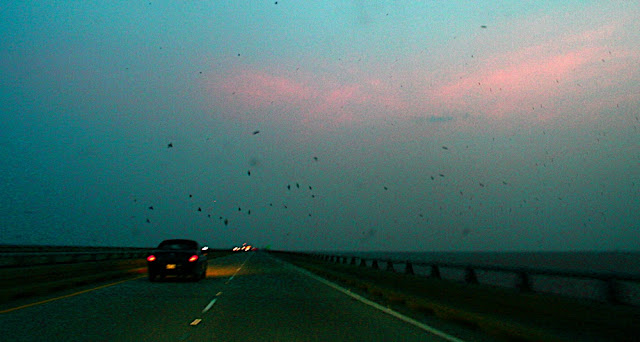
Unfortunately, more creepy crawlies were in store for us, as Giacomo was hiding out in my hairband on the mantle when we got home. Brie found him and screamed. These pictures… they just don’t do him justice, but maybe you can get some sense of the vast roachiness of him.


 Ah, Giacamo, you put up a good fight. Too bad I had to destroy you. Thanks for sending all of your kin to avenge your death.
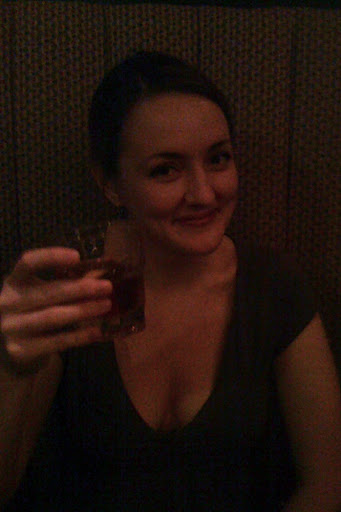
 To reward ourselves after the Battle of the Mantle, we tried Sazeracs at the Carousel Bar. Sazeracs were America’s first cocktail, invented in the French Quarter in the 1830s by a Creole pharmacist named Antoine Peychaud, when alcohol was hard to get and often poor quality, and needed mixers in order to be drunk. At the time a Sazerac was made of brandy, bitters, and absinthe. I liked mine. Brie not so much.
Good job hanging in to the end of the post. Here’s to you, Blog Reader. Here’s to you.




 Posts
Posts


